
Setting up a home shrine
For those who practise meditation (Zazen) at home within a Buddhist tradition, setting aside a small area dedicated to the practice can aid concentration.
These days meditation comes in all shapes and sizes. With growing interest in meditation, many secular forms have developed for those who find the pace of life too hectic and would like some time to ‘de-clutch’ for a while.
However, meditation traditionally comes from a religious context. All the major religions (and a few minor ones) use forms of meditation, not simply for relaxation, but as a means of developing insight and facilitating inner change.
When we set up a shrine, therefore, it becomes a symbolic representation of that ideal. In this way, we expand our meditation practice to include acts of devotion such as bowing, lighting incense and candles, and chanting prayers or sacred texts before this symbolised ideal.
In Buddhist practice, the picture or statue of the Buddha represents the ideals of Wisdom and Compassion, the two pillars on which the edifice of Buddhism stands.
When we bow to the Buddha, we are bowing to these ideals as the highest values towards which we aspire.
There is an important difference between a promise and a vow. A promise can be broken, whereas with a vow we freely acknowledge that we may fall short of it; nevertheless, we continue to move in that direction, however imperfectly.
An ideal represents something towards which we aspire, and there should be at least some feeling behind that aspiration.
A home shrine can consist of a small table or even the corner of a shelf. We can invest in a Buddha statue (sometimes referred to as a Buddha rupa), or simply select a picture. If using a picture, it can be useful to mount it on stiff card for protection. Try to find a whole-body image of the Buddha rather than simply a Buddha head: the body represents the whole being, and in mindfulness the body is central to our practice.
Either way, take time to select an image that evokes some genuine feeling towards the aspiration it represents.
This is important because when we bow before the image, there should be some feeling in that bow—some warmth. If the bowing is merely mechanical, the feeling becomes disconnected from the aspiration. The state of the heart is always central to both meditation and mindfulness.
Sometimes we will stand before the image experiencing wanting, anger, frustration, fear or sadness. If, over time, we have developed a genuine feeling towards what the image represents, this can act as a lever, creating space around troublesome emotions and allowing us to practise compassion towards them. We never seek simply to ‘get rid’ of so-called ‘negative’ feelings, as they represent the state of our own heart at that moment.
On the shrine we might also have a flower or potted plant representing Nature. This also represents our own Buddha-nature, which is what we are to realise in ourselves and in all beings.
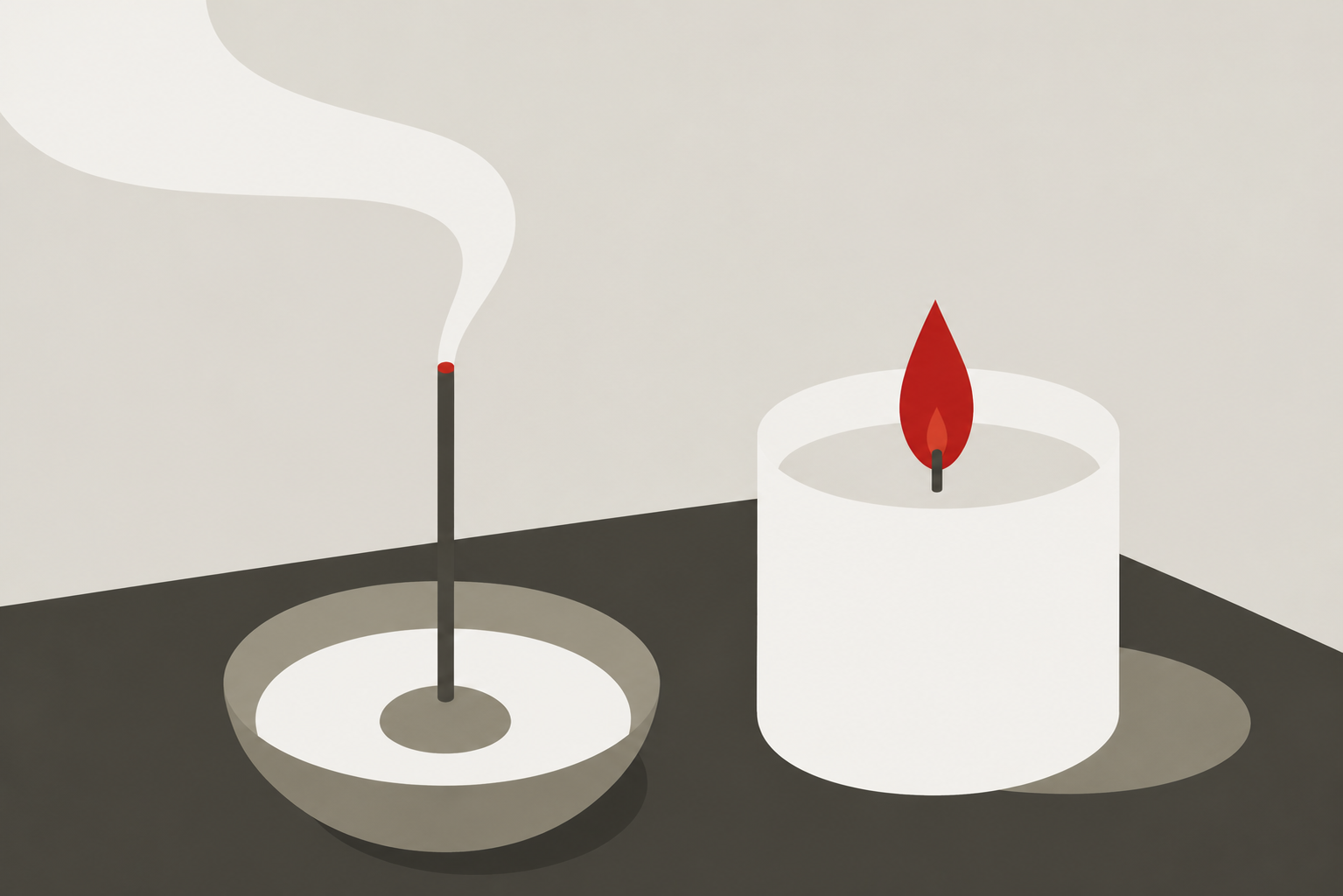
Candles and incense are optional, and please remember to exercise proper caution when using them in the home. Never leave candles or incense burning unattended.
If space permits, some people may include other offerings, such as tea or food. These are nice additions but are not at all essential.
What is important is the care taken in both setting up and maintaining the shrine. After all, it represents our highest values and aspirations and, over time, will perfume the meditation practice, lifting it beyond the narrow confines of ‘I’ and opening out the heart to greater possibilities.


