
EPISODE 21
Walking the Land Back into Harmony
The Alchemy of Transformation
A pilgrimage to a holy site invites questions about Buddhist practice and our ability to take action. The Zen masters were clear about the trap of picking one side over another, how then should we act in the world?
 © shutterstock
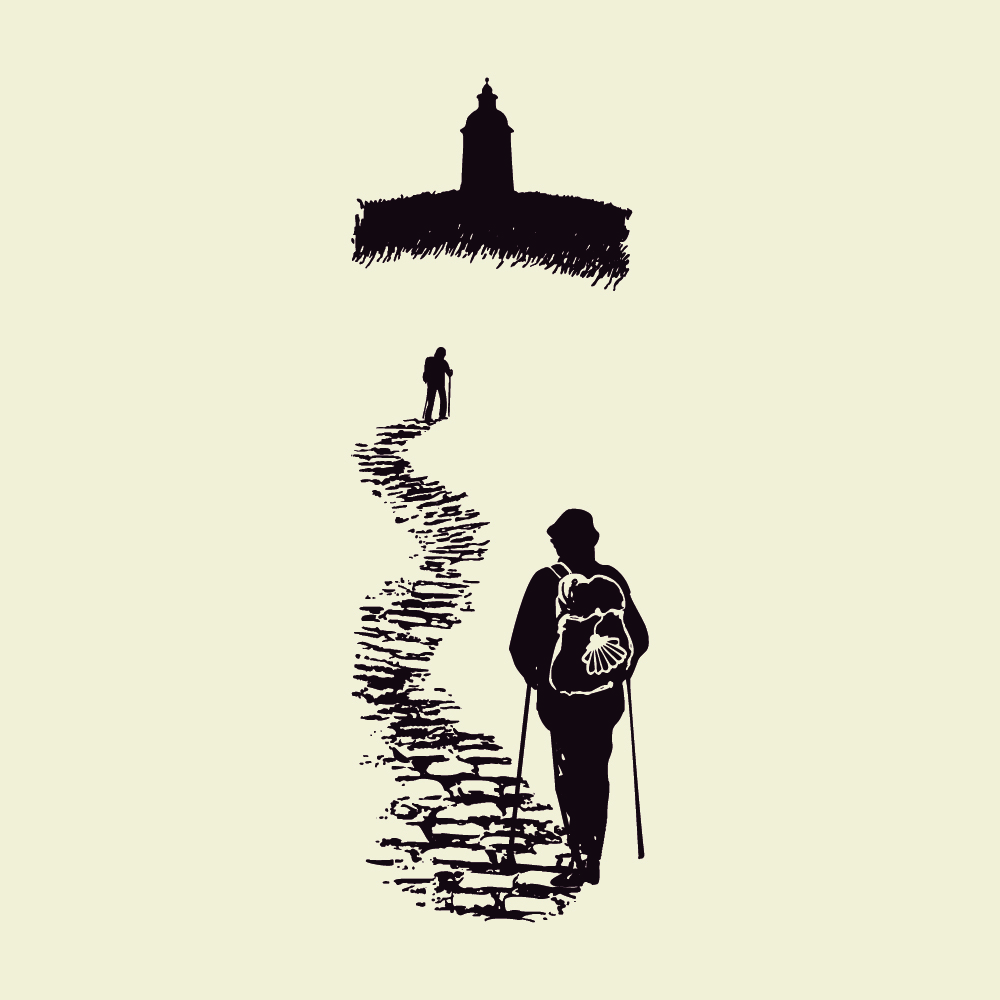
In September 2025, I visited Athos with a group of friends on pilgrimage. For those who don’t know, Athos is in Greece but is not quite ‘of’ Greece. The Athos peninsula, famous for its mountain and for being the heart of Greek Orthodox Christianity, can be found in the east of the country. It is an autonomous region governed by the monks of Mount Athos, with a network of twenty monasteries spread across the peninsula.
My inclusion in the group was rather last-minute. My friends, who included one recent convert to Orthodox Christianity, invited me because there was a spare place going. The thought of going on pilgrimage is something that has appealed to me for a long time.
I knew a couple of people who had undertaken the Camino, the pilgrimage to Santiago de Compostela in Spain, and since going to Athos I’ve heard of several more acquaintances who have also made the journey. Their reasons for doing so were varied. One person had recently experienced the death of a partner and wanted to take some ‘time out’ from her ‘normal’ world (which no longer felt normal) in order simply to walk herself back towards some kind of reconciliation with her changed situation. Going out in order to come back home, if you like. Others have made the walk for different reasons, but mainly for the experience of going on pilgrimage. I wonder whether it may also represent an attempt to reconnect with something that modernity sometimes lacks: a sense of tradition and of past values.
For myself, I did not really know why I wanted to do it, only that I did. Upon my return, I vowed to undertake one pilgrimage per month, and since then I have kept that promise. Back in Britain, my pilgrimages have been shorter—one or two days at most—and the destinations have varied: churches dedicated to various saints, springs and wells, and even one Neolithic site.
What emerged was the realisation that having an intention, a purpose to the endeavour, felt important. As a Zen practitioner, I found this interesting. Master Rinzai famously said, “All deliberation of heart misses the target.” However, Right Intention is the second stage of the Noble Eightfold Path. As the Buddha suggests in the Vimalakīrti Sūtra, although one cannot build a palace in empty space, the bodhisattva nevertheless undertakes the apparently impossible task of creating a Buddha-field for the sake of liberating living beings.
Spiritual practices are intentional and thus may ‘miss the target’, but they may fly closer to it than not undertaking any practice at all.
When I came back from Athos, having decided to undertake monthly pilgrimages, the question arose: what was to be their purpose?
Probably like most of us, I’ve been feeling increasingly worried about the times we are living through. Although I’ve never been particularly ‘political’, I did my share of marches in my younger years. More recently, however, it seems to me that there is a general miasma penetrating political and ideological discourse at present. The increased polarisation is much discussed in the mainstream, so it is hardly a figment of the imagination. The problem seems to be that to say anything in such an atmosphere is to add to it. And yet to step back from it, to retreat from it, also seems to miss something important. Thus, what to do?
The truth is that I have no solution, and I’m not sure anyone else does either. Mahāyāna thought is clear that opposites are interdependent. I could put up a flag on a lamppost in my street, or I could shout down someone else who does so. By playing into the opposites in this way, Mahāyāna thought suggests, we lay down the seeds for their continuance. This is why Master Rinzai says that intention misses the target.
I realise that it may be contentious in some quarters to suggest that activism can itself become part of the problem. The Nigerian philosopher Báyò Akómoláfé makes this point when he asks: What if the way we respond to the crisis is part of the crisis? To be clear, there are times when action is necessary but there are also times when it increases the trouble, creating silos, increasing polarisation and fragmenting those who live side by side.
The word we use for not-knowing in Buddhism is avidyā, literally ‘not-seeing’, or ignorance. This bind may seem impossible to escape, and in one way it is. Yet it is also necessary to recognise it, because the next stage is to let go completely by confessing: ‘I do not know what the solution is.’
It is from this point that something else can flow, because now we must ask for help.
Traditionally, refuge is sought in three things: the Buddha, the Dharma and the Sangha. The Dharma can mean the teachings, but those teachings are pointers towards a deeper understanding of what is sometimes called the Principle—the spiritual foundation of all things. Ultimately, this is what the Buddha saw under the Bodhi Tree when he ‘awoke’ and became the Buddha—the Awakened One. It is not necessary to understand what the Dharma is. In fact, it is a mystery whose nature ‘passeth beyond human understanding’ [1]. This does not prevent us from taking refuge in it.
The intention, then, was a straightforward one: to dedicate the merit accumulated by these pilgrimages to the renewal of this land.
Some might wonder: why not the globe rather than just a small portion of it? The globe is too large for me to imagine and feels too abstract, but the ground I’m walking on is right here, underneath my feet. Connecting with what we can see is fine too, and is not as exclusive as it may sound. When we chant for the welfare of someone, we are chanting for the benefit of all beings. Due to the interconnected nature of all things, to help one is to help all anyway. Keeping it local, however, helps with that connection to something larger than me. Again, it is not ‘my’ solution. This is given to the Dharma, and the Dharma is everywhere.
Pilgrimages, then, often have intentions behind them. In medieval times, one common reason was penance. Perhaps the most famous example from English history was the penitential pilgrimage of Henry II to Canterbury Cathedral after the assassination of Thomas Becket.
Penance is an interesting word. While it means to repent, it can also point towards reconciliation. The understanding is that when a moral offence is committed, an imbalance is created that must somehow be rectified. This is the basis for the figure of Justice carrying her scales. Penance is an act of hardship through which this balance may be restored.
Another age-old belief is that when calamity strikes, it is at least partly connected with moral wrongdoing. In the West, traditionally, it is the Deity who punishes; in Buddhism, we bear the consequences of our own unwholesome actions and are ‘punished’ by them. Living in this time, traditionally we are seen as also being ‘of this time’, karmically, and thus we can all participate in whatever it is that is going wrong. Therefore, it makes sense to atone. Even though there may be no personal responsibility, it is possible to undertake penance in order to help right the wrong. Just as in the Chinese rainmaker story [2], where the rainmaker first put himself back into harmony with the Tao and, in doing so, the drought-stricken land also returned to harmony.
This practice, which started last September, will finish in October this year with a final pilgrimage to the shrine at Walsingham, accompanied by the same group of friends with whom I went to Athos last year.
It has been a fascinating experiment that has opened up an opportunity to participate in our times as they are.
It is, perhaps, a way of hanging a flag from a lamppost without hanging a flag at all.
[1] ‘passeth understanding’ quote from Philippians 4:7
[2] The Chinese Rainmaker story was told to C. G. Jung by the sinologist Richard Wilhelm and was frequently retold by Jung.

