
Why sit, and what to expect
Meditation will not make you a better person, and it is not a cure-all. What it can actually do — and the body, mind and heart it works on.
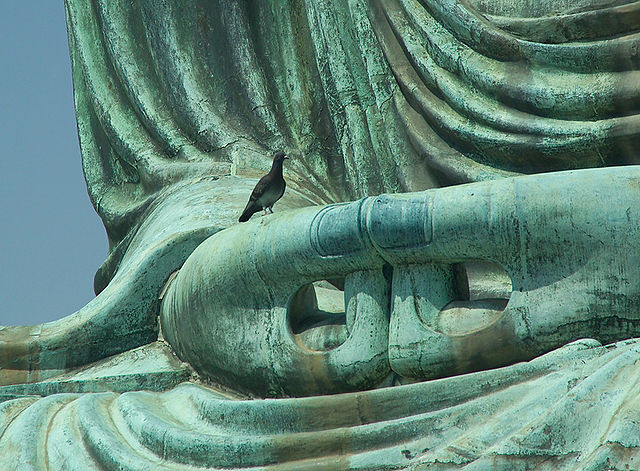
Hands of Amitābha statue at Kōtoku-in, Kamakura, demonstrating mida no jōin, a variation of the Dhyāna Mudrā
Meditation was originally devised as part of a religious practice as a way to gain insight; this is its primary intention. However, nowadays much has been discovered of its therapeutic value and for this reason it has enthusiastically been taken up by medics and those quite uninterested in any spiritual value it may also possess.
The reason it has value as a tool for insight is that it seeks to clarify our state of awareness, so that whatever it looks at can be seen more clearly. It is not difficult to discover for oneself that the more that conscious awareness is clouded by long thought streams, the easier it is to forget something important, or not to see something right in front of the eyes or not to take in something one is being told. Therefore the first thing to note is that the practice of meditation increases awareness by reducing the clutter of rampant thoughts, much of which are repetitive and often unhelpful in the situation just before one. It is important to make clear that it reduces, rather than eliminates, thought streams as thinking is a very useful tool. It is just that it is overused, and runs on in torrents bursting the banks if I’m all fired up about something or other; fired up by our anxieties, stresses and strains, our wanting and not-wanting.
As often happens with any ‘new discovery’, great claims are made for it, often over the top and in the end such hyperbole rarely delivers what it originally promised. So touching base with reality it is important to make clear that meditation alone is not a panacea to all my ills. Meditation itself will not make me a better person. Meditation will not mean that I will never again be upset, angry or find myself in a situation that I cannot cope with. What meditation can do is to supply another tool in the box with which to cope with the ‘slings and arrows of outrageous fortune’, along with all the other help available for specific problems that might be faced in life.
This is not a technique that produces instant results. It takes practice, and the instructions that follow — first on how to sit, then on what to do once you are sitting — are best read a couple of times before you try them out.
The practice of meditation takes into account:
Body
Mind
Heart
If one of these three is left out then it will not work properly. So, to begin we must take into account the body. The body is intimately connected with the functioning of the Mind and Heart (Mind is the centre of thinking, the Heart is the centre of feeling. These are not really two separate things, only described like this for convenience in order to refer to the two mental functions of thoughts and of moods/the emotional household). If you look at another person carefully and take into account the deportment of the body, the shape of the face, what the eyes are doing, how the hands are moving and so on it is easy to see in a glance what someone is feeling. What is not always immediately realised is that just as the Heart is reflected through the body, so it can work the other way around. That is, by altering the shape, deportment and behaviour of the body the mood or atmosphere of the Heart can be altered. This is what an actor learns to do; not just to ‘act’ but to ‘become’ in his heart the state which the character he is depicting calls for on stage.In meditation we are seeking to cultivate in the Heart a state of awareness that is collected and whose main characteristic is a quiet openness.
This ‘quiet openness’ is not the same as having no thoughts or even as not feeling an emotion; rather it is a state of Heart that is not carried away by thoughts and feelings even whilst thoughts and feelings continue to arise and fall in the Mind and Heart. There is a Chinese verse which sums it up:
Clouds swirling around the mountain peak
Do not disturb the stillness.
The mountain is the solidity of the body, which not thinking just is. The Heart and Mind produce the thoughts which swirl around, arising and passing away. Hopefully this conveys the state being suggested – often poetry is the best way to express inner states.
So the body needs to be set up like our proverbial ‘mountain’.


